In January 2025 I took a four-day (8 Module) course from the Association of Family & Conciliation Courts (AFCC) entitled “Advanced Issues in Family Law: Parent-Child Contact Problems.”
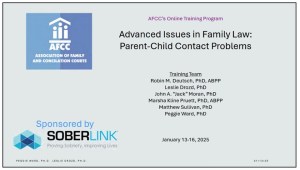
Based on the course curriculum and lecture content, I am concerned that there may have been an ethical violation by another psychologist – a group of psychologists – the instructors – of Standards 2.04 Bases for Scientific and Professional Judgments and 2.01 Boundaries of Competence of the APA ethics code.
Course Instructors:
Robin Deutsch, Ph.D.
Leslie Drozd, Ph.D.
John A. Moran, Ph.D.
Marsha Kline Pruett, Ph.D.
Matthew Sullivan, Ph.D.
Peggy Ward, Ph.D
I have mandatory (required) obligations under Standard 1.04 Informal Resolution of Ethical Violations of the APA ethics code when I believe there may have been an ethical violation by another psychologist (in this case a group of psychologists). Compliance with the APA ethics code is not optional for psychologists, it is mandatory-required, including my compliance with Standard 1.04 when I believe there may have been an ethical violation by another psychologist.
1.04 Informal Resolution of Ethical Violations
When psychologists believe that there may have been an ethical violation by another psychologist, they attempt to resolve the issue by bringing it to the attention of that individual, if an informal resolution appears appropriate and the intervention does not violate any confidentiality rights that may be involved.
I contacted each of the instructors individually to make them aware of the concerns. Based on their response and the scope of the issues, the ethical concerns were not properly resolved by informal notice provided to the instructors, and my required (mandatory) obligations under Standard 1.05 Reporting Ethical Violations were activated.
1.05 Reporting Ethical Violations
If an apparent ethical violation has substantially harmed or is likely to substantially harm a person or organization and is not appropriate for informal resolution under Standard 1.04, Informal Resolution of Ethical Violations, or is not resolved properly in that fashion, psychologists take further action appropriate to the situation. Such action might include referral to state or national committees on professional ethics, to state licensing boards, or to the appropriate institutional authorities.
Pursuant to my required obligations under Standard 1.05, I notified the APA Ethics Committee as representing a national committee on professional ethics regarding the potential violations to Standards 2.04 & 2.01 of the APA ethics code by the instructors of the AFCC course.
I followed-up this notice to the APA Ethics Committee (a national committee on professional ethics) with a notice to the AFCC Board of Directors representing the appropriate institutional authority providing the course.
Experimenting on Human Subjects
Of prominent professional concern is that the forensic psychologists in the family courts are conducting an experiment on human subjects (the children and parents in the family courts) without proper oversight regarding a “quasi-judicial” role for doctors and an experimental assessment approach called forensic custody evaluations (parenting plan assessments) for this experimental new quasi-judicial role for doctors, in apparent violation of the principles of the Belmont Report (1979) on conducting experiments with human subjects.
Vulnerable Population
The parents and children in the family courts represent a “vulnerable population” who require special safeguards for the following reasons:
1) Compromised Autonomy: the parents have compromised autonomy in their decision-making surrounding their lives and their parenting because of the court’s involvement.
2) High-Need for Services: the parents and children have a high need for mental health services because of the severity and nature of the pathology in the family.
3) Specialized Knowledge: professional competence requires specialized knowledge in multiple domains – attachment – delusional thought disorders – factitious disorders – narcissistic-borderline-dark personality pathology – child abuse & complex trauma – family systems.
Experiments on human subjects (the parents and children in the family courts) who are a vulnerable population because of their characteristics should NOT be conducted without proper oversight.
A Failed Experiment
The experiment of a quasi-judicial role for doctors that was conducted on children and parents in the family courts has been a complete failure. As a result of the failed experiment conducted on human subjects in the family courts, the lives of thousands and thousands of children and their parents were irrevocably destroyed.
When an outside and independent review of forensic custody evaluations was conducted by the New York Blue-Ribbon Commission on Forensic Custody Evaluations (2021), they found the practice of forensic custody evaluations to be dangerous and harmful to children, to lack scientific or legal value, and that it produces defective reports leading to potentially disastrous consequences for parents and children.
From NY Blue Ribbon Commission: “In their analysis, evaluators may rely on principles and methodologies of dubious validity. In some custody cases, because of lack of evidence or the inability of parties to pay for expensive challenges of an evaluation, defective reports can thus escape meaningful scrutiny and are often accepted by the court, with potentially disastrous consequences for the parents and children. By an 11-9 margin, a majority of Commission members favor elimination of forensic custody evaluations entirely, arguing that these reports are biased and harmful to children and lack scientific or legal value. At worst, evaluations can be dangerous, particularly in situations of domestic violence or child abuse – there have been several cases of children in New York who were murdered by a parent who received custody following an evaluation. These members reached the conclusion that the practice is beyond reform and that no amount of training for courts, forensic evaluators and/or other court personnel will successfully fix the bias, inequity and conflict of interest issues that exist within the system.” (NY Blue-Ribbon Commission on Forensic Custody Evaluations, 2021)
Clinical Diagnostic Assessments
The only cause of severe attachment pathology (a child rejecting a parent; a directional change in a primary motivational system for love and bonding) is child abuse range parenting by one parent or the other.
Targeted Parent Abusive: either the targeted parent is abusing the child in some way, thereby creating the child’s attachment pathology toward that parent,
Allied Parent Abusive: or the allied parent is psychologically abusing the child by creating a shared persecutory delusion and false (factitious) attachment pathology in the child for secondary gain to that parent.
The potential secondary gain to the narcissistic-borderline-dark personality parent for creating false pathology in the child includes:
- Court Manipulation: manipulating the court’s decisions regarding child custody in favor of the allied parent by creating false pathology in the child to deceive the court regarding the normal-range parenting of the targeted parent.
- Spousal Abuse: spousal emotional and psychological abuse of the targeted parent (in revenge and retaliation for the failed marriage and divorce) using the child, and the child’s induced pathology, as the spousal abuse weapon.
- Regulatory Object: the narcissistic-borderline-dark personality parent is using the child as a “regulatory object” to meet the allied parent’s own emotional and psychological needs (for narcissistic supply and to allay abandonment fears).
Dangerous Pathology & Duty to Protect
All mental health professionals have duty to protect obligations whenever they encounter three types of dangerous pathology, suicide, homicide, and abuse (child, spousal, and elder abuse).
From Wikipedia Duty to Protect: “In medical law and medical ethics, the duty to protect is the responsibility of a mental health professional to protect patients and others from foreseeable harm.”
Whenever a dangerous pathology is encountered (suicide, homicide, abuse), duty to protect obligations are active and the mental health professional must do three things:
1) Risk Assessment: The mental health professional must conduct a proper risk assessment for the danger involved or ensure that a proper risk assessment gets conducted (such as by referring a suicidal patient to the ER for evaluation or making a report to Child Protective Services for the risk assessment of possible child abuse).
2) Protective Action: The mental health professional must take an affirmative protective action to ensure everyone’s safety (such as referral for additional evaluation and treatment, increased frequency of sessions, or activating surrounding family and social support with proper permissions).
3) Documentation: The mental health professional should then document in the patient’s medical record the findings from a risk assessment if one was conducted, and the affirmative protective actions taken.
Failure to conduct a proper risk assessment when a risk assessment is warranted by the symptoms and context may represent a negligent failure in duty to protect obligations.
Cornell Law School Definition of Negligence: “Negligence is a failure to behave with the level of care that someone of ordinary prudence would have exercised under the same circumstances. The behavior usually consists of actions, but can also consist of omissions when there is some duty to act.”
Craig Childress, Psy.D.
Clinical Psychologist
WA 61538481
OR 3942 – CA 18857
 Dr. Childress Consulting